
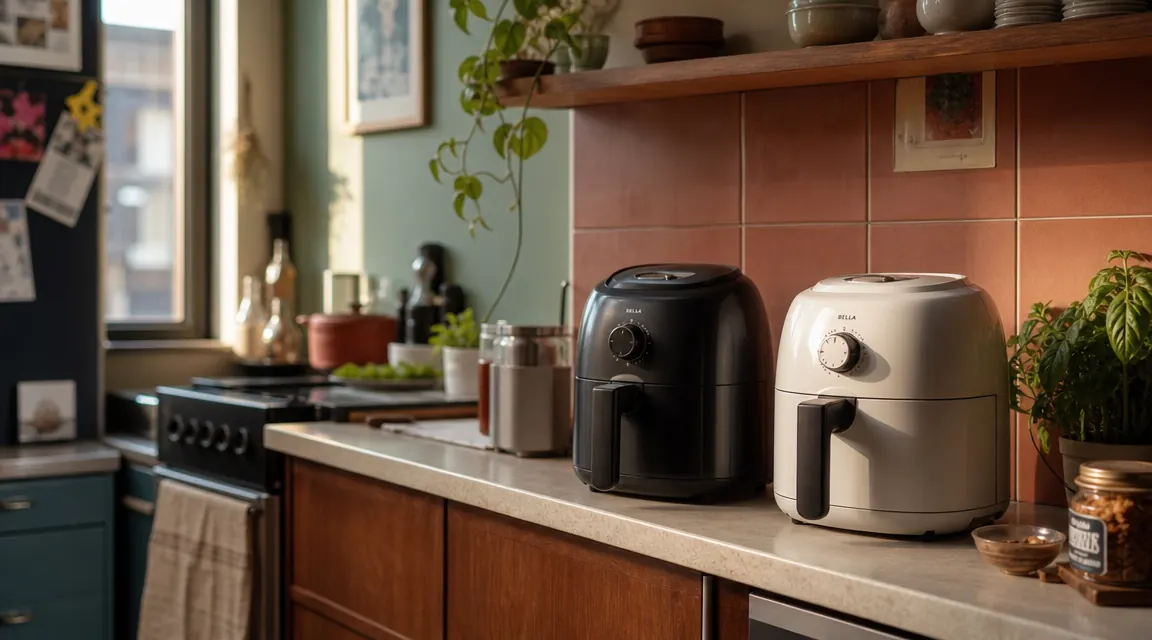
Counter space in a small kitchen is not free. Every appliance that lives on mine has to do something the others cannot, take up as little room as possible, and be easy enough to clean that I actually use it. So when I was choosing between the Ninja AF101 and the Cosori 4-quart air fryer, I was not just comparing crisp levels. I was deciding which one had earned a permanent address on my eleven inches of open counter.
Both machines are 4-quart capacity, both promise rapid hot-air circulation, and both land in a similar price range. On paper they are nearly tied. In practice, though, there are real differences in footprint shape, basket design, control feel, and long-term cleanup that add up to a clear winner for a small-kitchen setup. Here is where each one stands.
| Feature | Ninja AF101 (Left) | Cosori 4-Quart (Right) |
|---|---|---|
| Capacity | 4 quarts | 4 quarts |
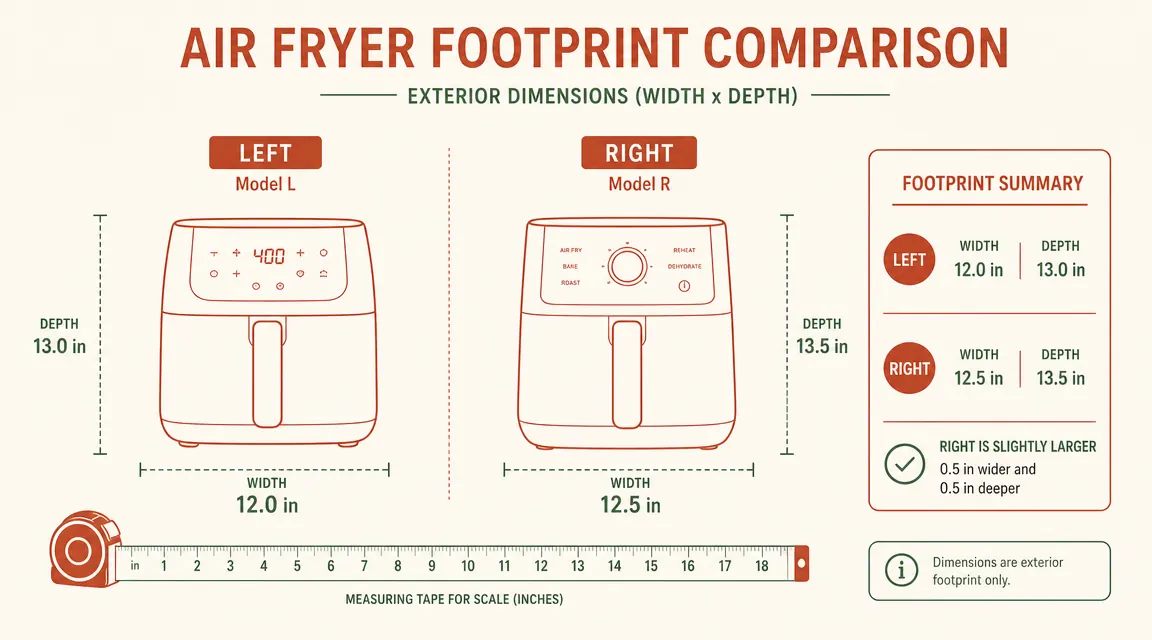
| Footprint (approx.) | 11.1 in wide x 11.5 in deep | 11.8 in wide x 11.0 in deep |
| Wattage | 1550W | 1500W |
| Temp range | 105°F to 400°F | 170°F to 400°F |
| Minimum temp (dehydrate/proof) | 105°F | 170°F |
| Controls | Two analog dials | Digital touchscreen |
| Preset programs | None (manual dials) | 11 presets |
| Crisper plate style | Flat with low ridges | Raised square ridges |
| Basket release mechanism | Push-button side release | Push-button top handle |
| Dishwasher safe parts | Basket and crisper plate | Basket and crisper plate |
| Noise level | Moderate hum | Slightly louder fan |
| Price range | See current price on Amazon | Similar price range |
| Rating (Amazon) | 4.7 stars, 90,000+ reviews | 4.8 stars, 50,000+ reviews |
Where the Ninja AF101 Wins
The first thing I noticed about the Ninja AF101 was the temperature floor. It goes down to 105 degrees Fahrenheit, which the Cosori does not. That may sound like a technical footnote, but it means the Ninja can dehydrate herbs, proof bread dough, and dry-crisp jerky at temperatures the Cosori simply cannot reach. If you want to do more than fry with your air fryer, that lower range matters.
The dial controls are also a genuine advantage in a small kitchen. I know touchscreens look sleek, but I have cooked next to a steaming pot of pasta and tried to adjust a digital panel with slightly damp fingers. The Ninja's two analog dials require no precision tapping. You spin one for time and one for temperature, and you are done. No menus, no modes, no accidental resets. There is something to be said for a machine that does what you told it without requiring you to speak its language first.
The Ninja also edges out the Cosori on footprint shape. At 11.1 inches wide, it fits into a narrower cabinet gap or a tighter corner than the Cosori's 11.8-inch width. That 0.7-inch difference sounds trivial until you are measuring between your microwave and the edge of your stovetop. I have been in that situation. Every fraction of an inch counts.
Cleanup favors the Ninja slightly as well. The flat crisper plate with low ridges releases stuck-on bits more easily than the raised square ridges on the Cosori plate. Both are dishwasher safe, but if you hand-wash between loads the way I do most evenings, smoother ridges mean a faster wipe-down. That matters on a Tuesday night when dinner happened at 7:30 and you just want to be done with the kitchen by 8.
If your counter has eleven inches to spare, the Ninja AF101 earns them.
More than 90,000 Amazon reviewers have put this machine through its paces. Check today's price and see current availability.
Amazon Check Today's Price on Amazon →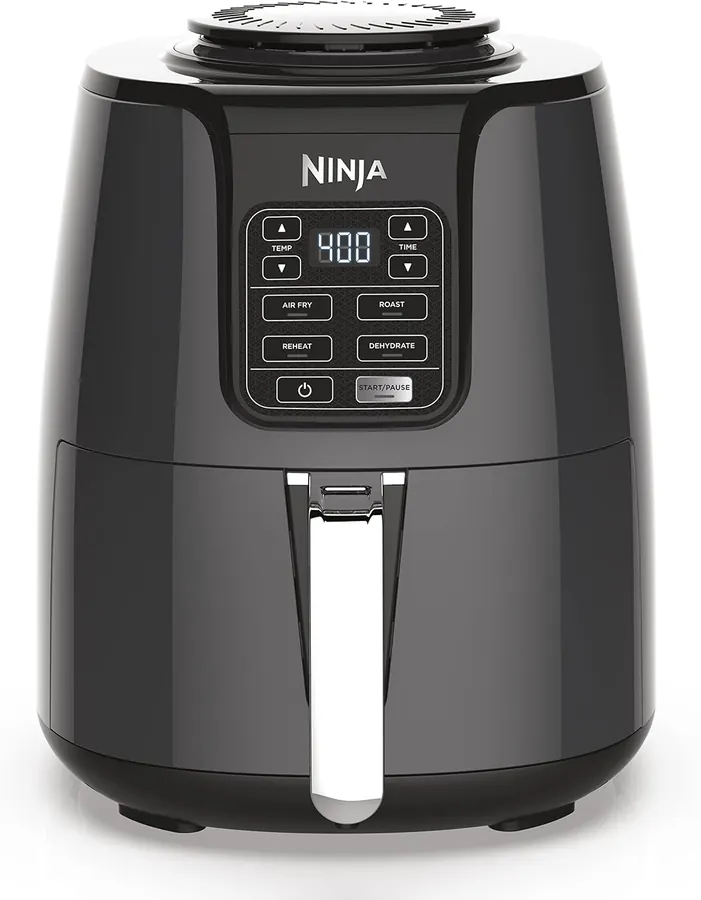
Where the Cosori Wins
The Cosori has a real edge in the preset department. Eleven one-touch programs cover the most common foods, from frozen fries to shrimp to steak, so if you are newer to air frying and want a little guidance, those programs take out some of the guesswork. The Ninja's dial controls are simpler to operate once you know what you are doing, but the Cosori's digital display is more helpful if you are still figuring out timing and temperatures.
The Cosori's basket handle design also gets credit. The top-mounted push-button handle is very intuitive and the basket locks securely. A small thing, but it feels slightly more solid when you pull a hot basket out at arm's length. The Ninja's side-release button is not difficult, but the Cosori's handle action feels like it was thought through by someone who pulls baskets out of hot air fryers frequently. Both are safe and functional. The Cosori's is just a touch more satisfying.
In a small kitchen, you are not just choosing between two air fryers. You are choosing which machine gets a permanent address on eleven inches of counter real estate. That decision deserves more than a quick spec comparison.
Real Cooking Performance: Where They Actually Differ
On the most common small-kitchen tasks, these two machines perform very similarly. Frozen fries at 400 degrees for twelve minutes come out crispy and golden in both. Chicken thighs at 380 degrees for twenty minutes develop a good skin in both. Reheated pizza at 350 degrees for four minutes is better in either of these than it would ever be in a microwave, regardless of which you choose.
The separation shows up at the edges. The Ninja's wider temperature range opens up dehydrating and gentle warming. The Cosori's presets give beginners a safety net on timing. For someone who cooks a lot of variety, the Ninja's flexibility wins. For someone who wants to pop in a bag of frozen shrimp and press a button, the Cosori's presets are genuinely useful. Neither machine outperforms the other at the core task of making things crispy. They just serve different cooking styles.
Noise level is worth mentioning. Both run a continuous fan, but I found the Cosori noticeably louder when cooking at high heat. In an apartment with an open layout, that fan sound carries into the living room. The Ninja has a moderate, steady hum that I stopped noticing after a few uses. If your kitchen is open to a small living area and you watch television while you cook, the Ninja is quieter company.

Who Should Buy the Ninja AF101
The Ninja AF101 is the right choice if you want one compact machine that can roast, reheat, crisp, and dehydrate without requiring you to navigate a digital menu every time. The analog dials are fast, the low-temperature range is genuinely useful for more than frying, and the slightly smaller footprint helps in a tight kitchen. If you have been cooking for a while and know your temperatures, the Ninja gives you direct control without any fuss. It is the air fryer I keep on my counter, and at over 90,000 reviews on Amazon, the backing for that choice is substantial.
Who Should Buy the Cosori Instead
If you are new to air frying and want preset guidance, or if you strongly prefer a touchscreen interface over analog dials, the Cosori is a solid machine. Its basket handle is well designed, the presets do take the guesswork out of common foods, and the 4.8-star average reflects real satisfaction from a large buyer base. It is not my pick for a small kitchen where footprint and low-temperature range matter, but for someone who wants more hand-holding from their appliance, it earns that consideration.
One practical note: the Cosori does not get an affiliate link here because my recommendation is the Ninja. I mention it because leaving it out entirely would give you an incomplete picture, and that does not serve you. If you compare these two at your local store or on Amazon, you will see what I mean about the differences. Just walk away with the one that fits your cooking style and your counter.
For more detail on the Ninja AF101 specifically, including eight months of daily use notes and the few things I wish I had known earlier, see the long-term review here. And if you want the unvarnished take on what nobody mentions in the positive reviews, the honest review covers that too.
The Ninja AF101 has earned a permanent spot on narrow counters in a lot of small kitchens.
More than 90,000 Amazon reviews, a 4.7-star average, and a footprint that fits where other air fryers do not. See today's price before you decide.
Amazon Check Today's Price on Amazon →