
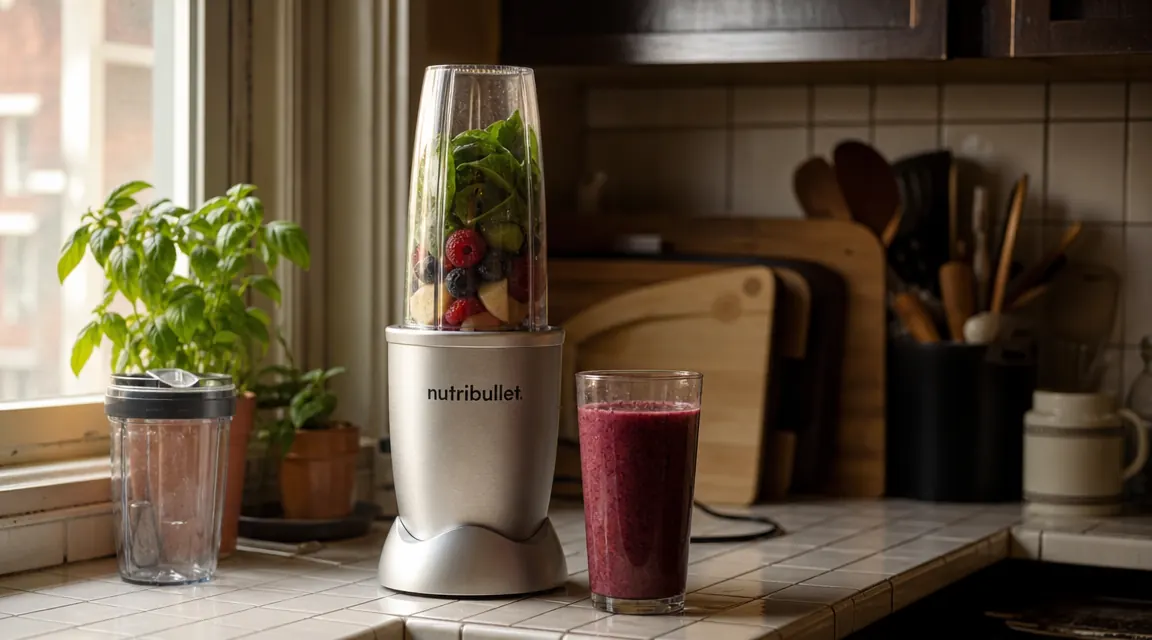
If you have been comparing the Magic Bullet and the NutriBullet, you have already made one smart decision: you are thinking personal blender, not full-size countertop monster. Both machines come from the same parent company. Both use the same cup-flips-onto-base design. Both are aimed at people who want a quick blend and a cup they can walk out the door with. The question is whether the extra cost of a NutriBullet gets you anything meaningful, or whether the Magic Bullet handles everything a small-kitchen cook actually needs.
Short answer: for most small kitchens, the Magic Bullet is the right buy. It is lighter, cheaper, takes up less counter space, and covers the everyday blending jobs without complaint. The NutriBullet earns its higher price for a specific kind of user, and I will tell you exactly who that is. But if you are not that person, you would be paying more for power you will rarely call on.
| Feature | Magic Bullet (left) | NutriBullet (right) |
|---|---|---|
| Motor | 250 watts | 600 watts (base model) |
| Cup capacity | 18 oz tall cup + 12 oz short cup included | 24 oz cup included |
| Base footprint | Approximately 4 inches wide | Approximately 4.5 inches wide |
| Weight | About 2.5 lbs | About 3.5 lbs |
| Pieces included | 11-piece set (2 cups, lids, lip rings, blade, flat blade) | 3-piece set (cup, blade, lid) |
| Typical use | Smoothies, sauces, dressings, baby food, spice grinding | Smoothies, frozen fruit, nut butters, protein shakes |
| Current price | See today's price on Amazon | Higher price tier |
| Amazon rating | 4.4 out of 5 (119,000+ reviews) | 4.5 out of 5 (separate listing) |
| Blade removal | Removable cross blade | Twist-off blade base |
| Winner | Better value, smaller footprint, more versatile kit | Better for daily frozen blends |
Where the Magic Bullet Wins
Counter space is the first conversation. I have about nine usable inches between my coffee maker and the cabinet corner, and everything that lives there has to justify its footprint. The Magic Bullet base is roughly four inches across at its widest point. It tucks in without crowding anything. When I am not using it, it looks tidy sitting there. The NutriBullet is wider and noticeably heavier, which sounds like a small difference on paper but translates to moving it more often if your storage options are limited. In a galley kitchen or any setup where you work around your appliances rather than beside them, those extra half-inches add up across the week.
The 11-piece kit is where the Magic Bullet genuinely pulls ahead for a small kitchen. You get a tall cup for a full smoothie, a short cup that is exactly right for a quick salad dressing or a batch of hummus, two different blade attachments, a set of lids that turn the cups into storage containers, and lip rings so you can drink straight from the cup. That flat blade is useful in a way people underestimate. It handles dry ingredients, including spice grinding, coffee beans, and fine-chopping onions, in a way the NutriBullet cross blade does not. For someone cooking real food in a small kitchen rather than just making protein shakes, that versatility matters more than raw motor watts.
Cleanup is also faster with the Magic Bullet. The cups are narrower and shorter, so they fit under the faucet easily and rinse clean without needing a bottle brush. I do a lot of single-serving sauces and dressings, and being able to rinse the cup in ten seconds, right at the sink, keeps me from avoiding the blender out of laziness. That ease-of-use factor is underrated in any small-kitchen appliance. The best blender is the one you actually reach for every time, and a fast-rinse cup design makes that easier.
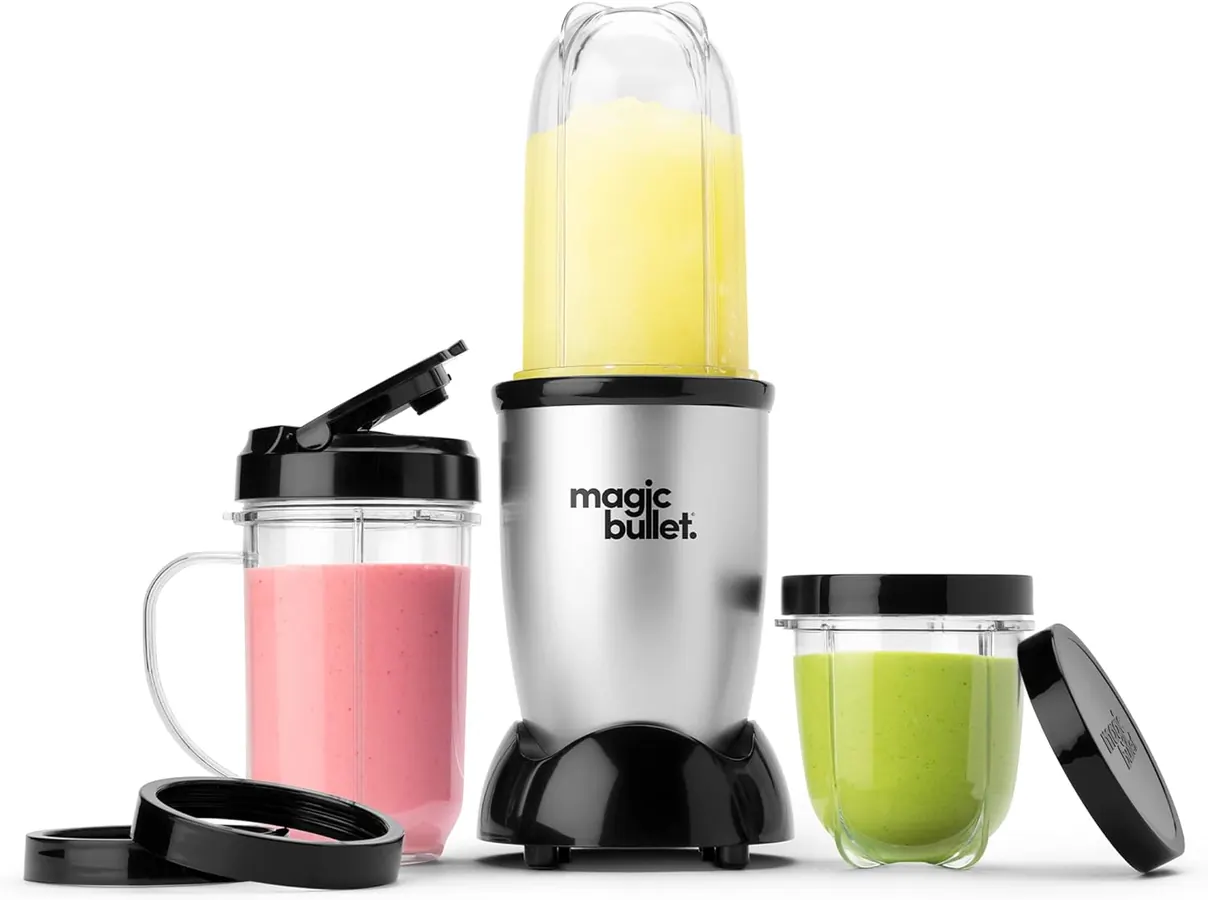
Where the NutriBullet Wins
I want to be fair to the NutriBullet, because it does earn its price for the right person. If your daily routine involves a full 24-ounce smoothie with a cup of frozen fruit, a handful of kale, a scoop of protein powder, and maybe some ice, the NutriBullet's 600-watt motor handles that load without strain. The Magic Bullet at 250 watts can do frozen fruit, but it takes longer, requires more liquid to get things moving, and the motor works harder. If you push it with dense frozen loads daily, you will notice the difference over time.
The NutriBullet's 24-ounce cup is also genuinely useful if you like a larger drink. The Magic Bullet's tall cup holds 18 ounces, which is the right size for most smoothies, but if you want a big post-workout shake or you are blending for two people in one go, the NutriBullet gives you more room. The taller cup is also easier to fill with a lot of ingredients without overpacking.
The Magic Bullet 11-Piece Set is the better fit for most small kitchens. Check today's price before it changes.
Over 119,000 Amazon reviews, 4.4 stars, and a compact footprint that earns its spot on a narrow counter. This is Sandra's pick for everyday blending without the bulk.
Amazon Check Today's Price on Amazon →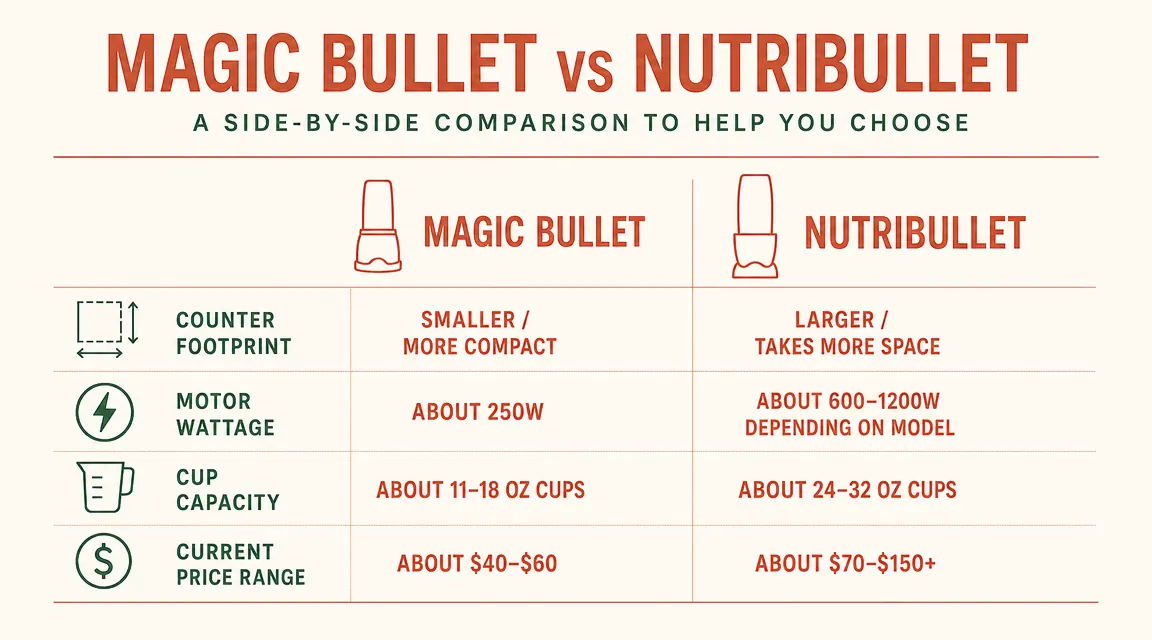
Power: Does 250 Watts Actually Get the Job Done?
The honest answer is yes, for most small-kitchen use cases. I use my Magic Bullet for frozen banana smoothies almost every morning, salad dressings two or three times a week, occasional hummus, and roughly once a month I grind spices with the flat blade. None of those tasks strain a 250-watt motor when you add enough liquid and cut your frozen fruit into chunks rather than dropping whole frozen berries in straight from the bag.
Where 250 watts falls short: very dense frozen blends with no added liquid, ice crushing, nut butters, and anything fibrous that really needs prolonged blending. If you tried to make a thick green smoothie with raw kale, frozen mango, almond butter, and very little liquid, the Magic Bullet would struggle. But that is also a use case that would frustrate most single-serving blenders at any price. The practical fix is to add a splash more liquid, blend in two short pulses, and the job gets done. Technique matters as much as wattage for everyday personal blending, and that is something no spec sheet tells you.
The Magic Bullet fits in nine inches of counter space, rinses clean in ten seconds, and handles every smoothie, sauce, and salad dressing I have thrown at it for a year. That is what a small-kitchen appliance is supposed to do.
Durability: What Holds Up and What to Watch
After a year of daily use, the Magic Bullet motor base has shown no signs of trouble. The blade still spins true, the locking mechanism engages cleanly, and the motor has not developed the burning smell that some blender motors produce when they are overworked. The main wear point is the rubber gasket on the blade assembly. If you leave the blade screwed onto a cup for days at a time with moisture trapped under it, you will eventually get a slow drip. The fix is simple: after washing, leave the blade off the cup until everything is fully dry, then reassemble for storage. That single habit extends the seal life significantly.
The NutriBullet has a similar gasket issue, though the blade base design puts the seal in a slightly different position. Both machines are built for single-cup, short-duration blending cycles, and both hold up well when used that way. Where either machine gets into trouble is extended run times. Neither is designed to run for two or three minutes straight. If you blend in short fifteen-second to thirty-second bursts, stop to check consistency, and continue only if needed, both machines will last considerably longer. The Magic Bullet manual actually specifies this, though the instruction booklet does not always make it into the box after unpacking.
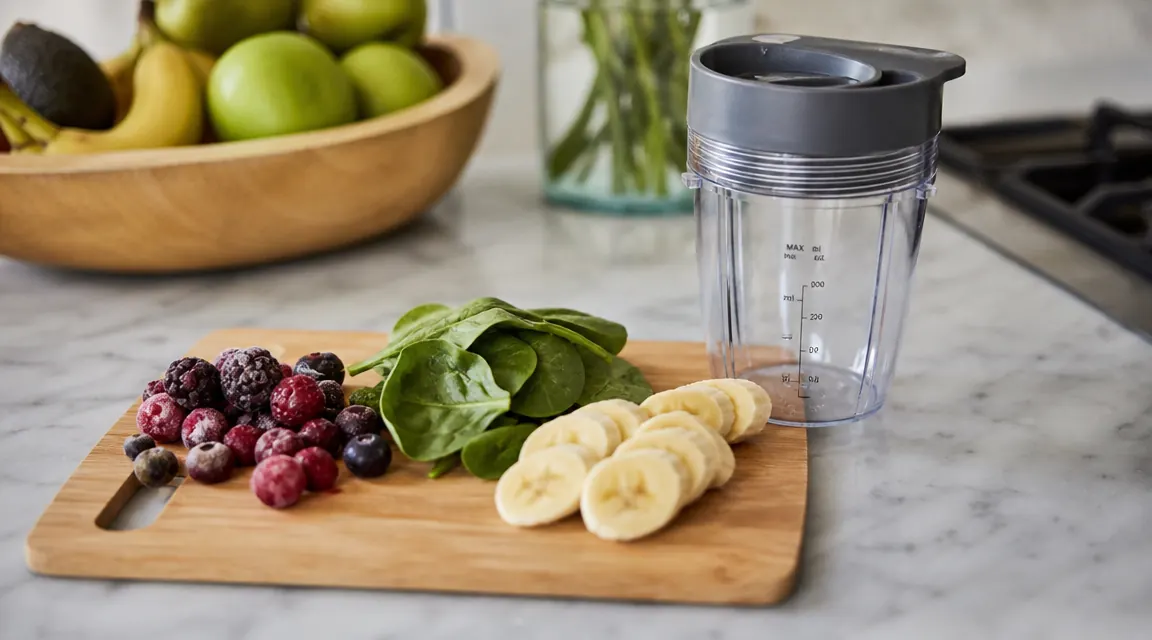
The Price Gap Is Real and Worth Thinking About
The NutriBullet costs roughly twice what the Magic Bullet does, depending on which NutriBullet model you compare. That price difference buys you more motor watts, a larger cup, and a slightly more robust blade seal over time. It does not buy you extra counter real estate, a better lid-storage system, or the flat blade for dry work. For someone on a budget or someone outfitting their first apartment kitchen, spending the difference on a good cutting board or a decent saute pan is probably the smarter call.
I also think a lot of people buy the NutriBullet expecting it to solve a blending problem that is actually a technique problem. If your Magic Bullet produces a chunky smoothie, the issue is usually ingredient order (liquids first, then soft produce, then frozen on top) and chunk size, not motor wattage. Fixing technique gets you a better result from a cheaper machine.
Who Should Buy Which
Buy the Magic Bullet if you are a home cook who uses a blender for a variety of tasks, not just one. If you make morning smoothies but also reach for it to blend a quick salsa, whir together a vinaigrette, or grind a handful of cumin seeds for a recipe, the 11-piece kit and the flat blade make the Magic Bullet the more useful machine. It costs less, takes up less space, and cleans up faster. For a rental kitchen, a dorm, an RV, or any situation where counter space is genuinely measured in inches, those advantages stack up. You can read my full one-year breakdown in the Magic Bullet blender review for even more detail on how it holds up day to day.
Buy the NutriBullet if you make a large, dense frozen smoothie every single day and convenience matters more than price. If your breakfast routine is a 24-ounce smoothie with frozen fruit, frozen spinach, and protein powder and you want the motor to handle it without any technique adjustments, the NutriBullet's extra power removes that friction. It is a specialized tool for a specialized daily habit. If that describes you precisely, the higher price is worth it.
If you are not sure, start with the Magic Bullet. At its price point you can try it without much risk. If you find yourself consistently fighting the motor or wishing for a bigger cup, you can upgrade then. But most people who try the Magic Bullet find it handles their actual blending life just fine, and the extra money never needed to be spent. For a deeper look at where it does and does not deliver, the honest review covers the things the box does not warn you about.
The Magic Bullet 11-Piece Set handles the everyday blending that matters most in a small kitchen.
Compact base, two cup sizes, a flat blade for dry work, and lids that double as storage caps. More than 119,000 Amazon reviews back it up. Check today's price below.
Amazon Check Today's Price on Amazon →