

I ordered the BLACK+DECKER TO1760SS on a Tuesday evening after reading exactly three other reviews, all of which said roughly the same thing: good value, fits small kitchens, makes decent toast. All three were correct. None of them told me what I actually needed to know before I started using it. I had to figure that out myself, over about the first four weeks of daily cooking in my Cincinnati apartment. The oven is still on my counter, still earning its keep, but I want to save you the four weeks of trial and error.
The BLACK+DECKER TO1760SS is a 4-slice toaster oven with a 1500-watt dual-element design and what the company calls natural convection. It has a 4.3-star rating from over 14,000 Amazon reviews, which is a meaningful signal. It also has a few quirks that show up predictably but that most reviewers gloss over. This piece is about those quirks, and about what I actually do to work around them. Think of it as the owner's manual they forgot to print.
The Quick Verdict
A capable, space-conscious toaster oven with a learning curve of about two weeks. Once you know its three main surprises, it stops being a source of frustration and starts being a genuinely useful everyday appliance.
Amazon Check Today's Price →If you cook for one or two people and your counter is tight, the TO1760SS is worth a serious look.
It fits a 4-slice footprint in about 16 inches of counter width, handles everyday baking and roasting, and the current price on Amazon keeps it well below the boutique competition.
Amazon Check Today's Price on Amazon →How I Tested This Oven
I have been cooking in small apartments for most of my adult life. Right now that is a 620-square-foot galley kitchen with eighteen usable inches of counter. I got the TO1760SS as a way to avoid firing up my full-size oven for small meals, and I have used it heavily since. For testing purposes, I tracked how long it took to heat up from cold each day for the first two weeks, measured the actual interior temperature against the dial setting using an oven thermometer I already owned, and paid close attention to how the convection setting actually behaved versus what I expected. I also cooked from scratch on it repeatedly: toast every morning, roasted vegetables three or four times a week, reheated leftovers at lunch, and baked a few batches of biscuits on weekends.
This is not a lab test. I am a home cook in a real kitchen, and my observations reflect that. What I can tell you is that every surprise I describe below showed up consistently, not just once. If something happened once it is not in here.
The oven I am reviewing has been in daily use for an extended period. The surprises I am about to walk through are baked into the design, not defects specific to my unit. Most of them are manageable with small habit adjustments. The one exception is the crumb tray, and I will explain exactly what I mean by that.
Surprise One: Heat-Up Time Is Longer Than You Expect
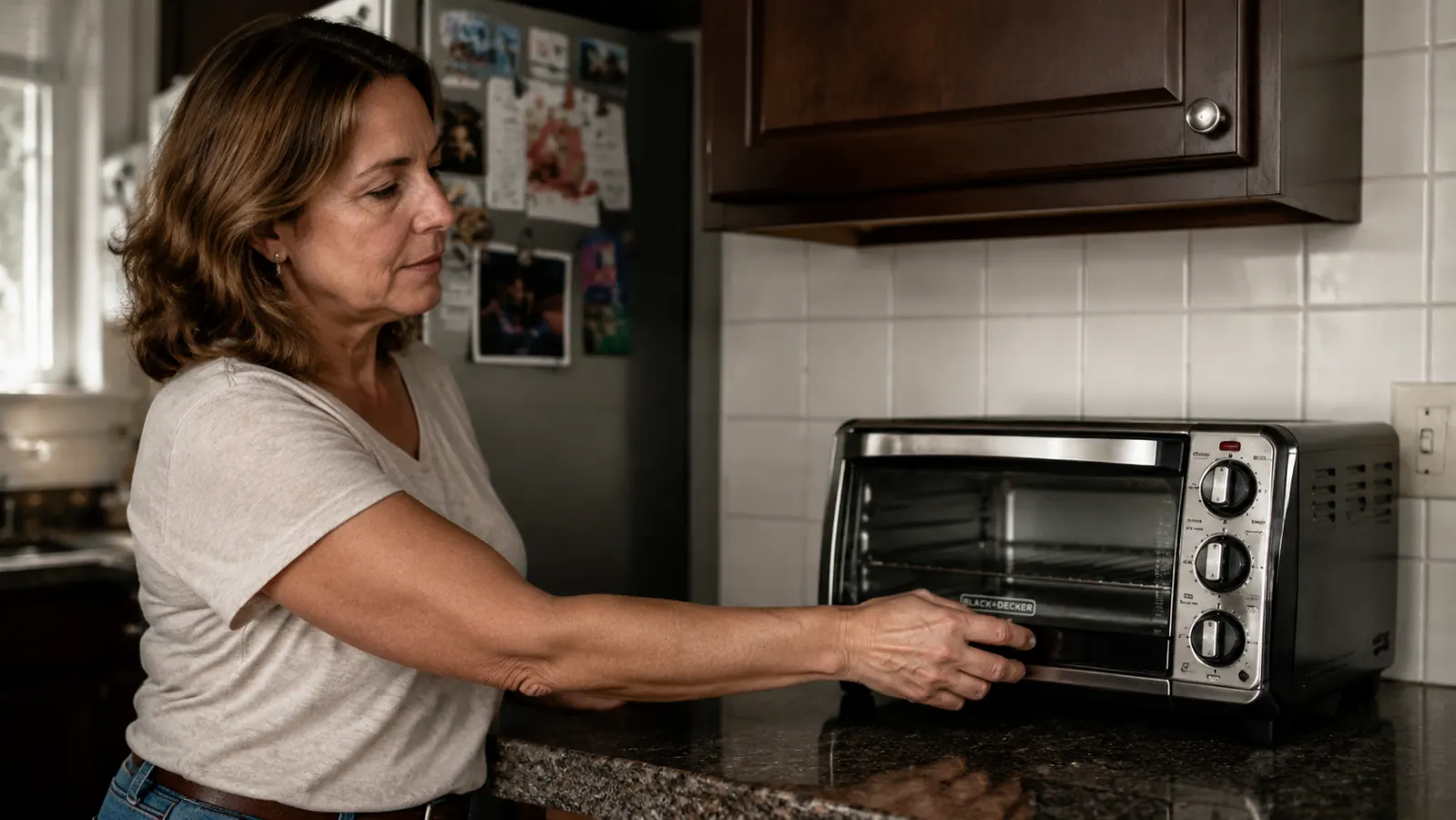
When I first plugged in the TO1760SS, I set it to bake at 375 degrees, gave it about ninety seconds, and slid in a tray of seasoned broccoli. The broccoli came out steamed and limp rather than roasted and slightly crispy. I repeated this with chicken thighs two days later and got the same underwhelming result. I blamed the convection setting. I was wrong to blame the convection setting.
The real issue was that I had not waited long enough for the oven to reach temperature. With my oven thermometer in place, I timed the actual preheat: from a dead cold start, the TO1760SS takes four to five minutes to reach 375 degrees, and closer to six minutes to reach 425. The elements do not have the mass of a full-size oven, so the first burst of heat happens quickly, but the air inside the small cavity takes time to stabilize at the set temperature. If you put food in during that stabilization window, you are essentially cooking in an oven that is still climbing.
My fix is simple: I set the dial, walk away, come back in five minutes, then put the food in. That is it. Once I built that habit, my roasted vegetables started coming out with the color and texture I expected. The oven performs well at temperature; the problem was entirely my impatience in the first week.
A five-minute preheat is not unusual for a toaster oven at this price point, but none of the reviews I read before buying mentioned it. Most people seem to skip the preheat entirely and then wonder why their results are inconsistent. Now you know.
Five minutes of preheat was the single biggest improvement I made to my results. The oven does not tell you to wait. It should.
Surprise Two: The Hot Spot Is Specific and Predictable
The TO1760SS runs hotter in the rear right corner. I want to be precise about this because vague hot spot warnings are not actually useful. The rear right corner, nearest the back heating element on the right side, runs noticeably hotter than the front left area of the rack. On a four-slice toast cycle, the rear right slice will be one shade darker than the front left slice at any given setting. On a baking tray, whatever sits in that rear right quadrant will be done two to three minutes before the rest.
Most toaster ovens at this price have a hot spot. That is not the surprise. The surprise is how consistent and predictable this particular one is. Once I understood where it was, I could use it deliberately. For roasting a tray of vegetables, I put denser items like potato cubes and carrot pieces in the rear right and faster-cooking items like broccoli florets in the front left. They finish at roughly the same time. For toast, I swap the front and rear positions halfway through the cycle on anything where I want even color.
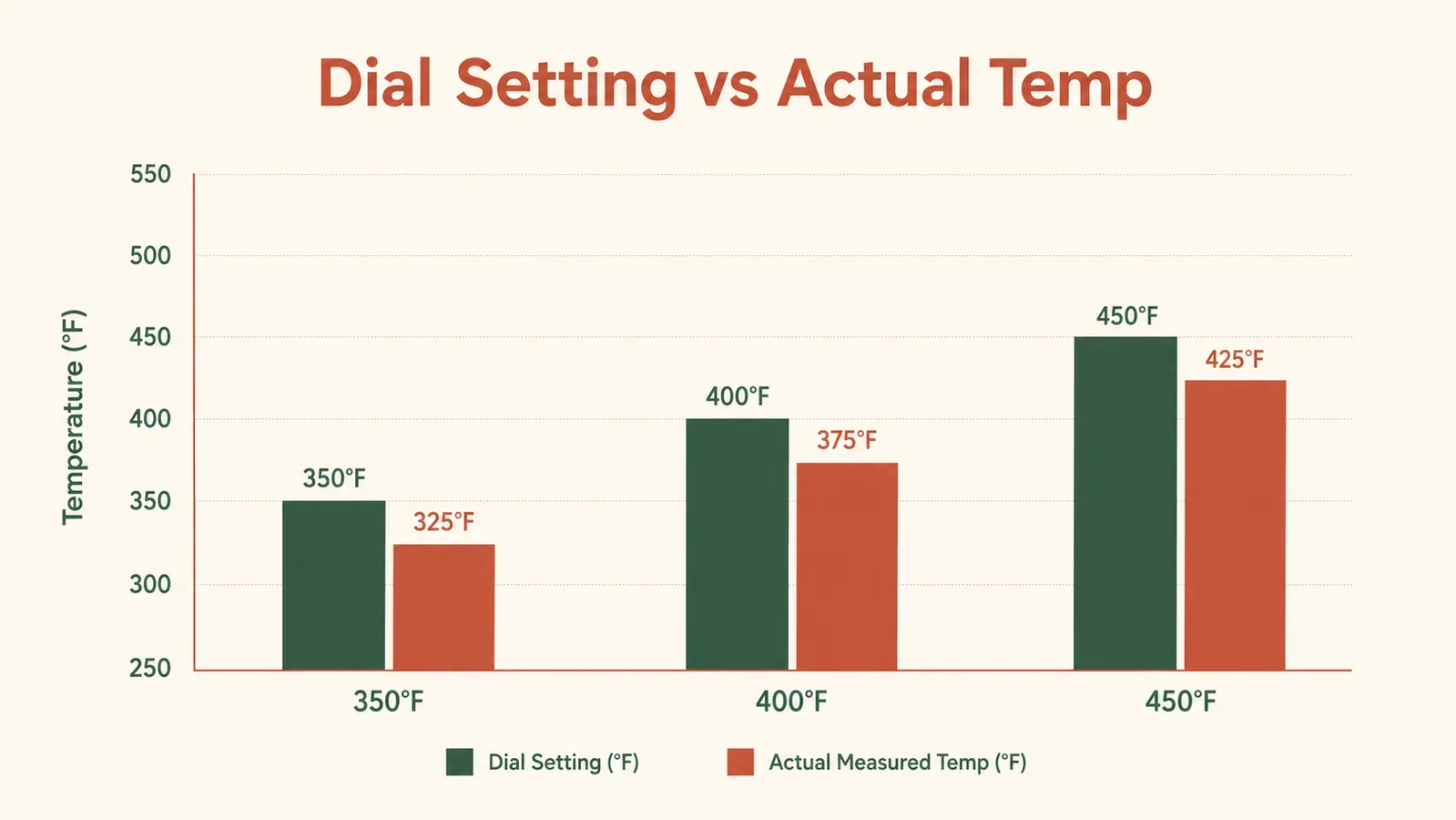
The oven also runs about fifteen to eighteen degrees hotter than the dial indicates at the center rack position. I set baking temperatures fifteen degrees below what any recipe calls for and check five minutes before the stated time. After a few weeks this becomes automatic, the same way you adjust for a full-size oven you have cooked on for years. But if you skip that adjustment, you will overbrown things and blame the oven when it is really just a calibration habit you have not built yet.
Surprise Three: The Crumb Tray Cleanup After a Greasy Cook
Dry crumbs are fine. The tray slides out, you shake it over the trash, and you put it back. That takes thirty seconds. The situation changes completely after you cook something with fat. Bacon, sausage, skin-on chicken thighs, anything where the fat drips, leaves a residue on the crumb tray that does not simply shake off. That residue, if left in place, smells the next time the oven heats up. Not dramatically, but enough to notice.
The crumb tray on the TO1760SS slides out from the front along the bottom of the oven interior. It is a thin metal tray with a low lip, which means it collects both crumbs and drippings but gives you very little depth to contain a heavy drip event. If you cook a lot of fatty proteins without lining the tray with foil, you will end up scrubbing baked-on grease off a tray that was not designed with deep cleaning in mind. The low lip also means that if you are not careful pulling it out, the grease can shift and spill.
My solution is foil. I cut a piece of aluminum foil to fit the tray loosely, fold the edges up slightly to create a small lip, and lay it in before any cook that involves fat. After the cook, I ball up the foil and replace it. Total time: about ninety seconds. The tray itself stays clean and the oven interior stays clean. If I forget the foil, I clean the tray in the sink with dish soap and a non-scratch sponge immediately while it is still warm. Baked-on grease that sits overnight is harder to remove, so immediacy matters.
This is not a design flaw exactly, more of a design tradeoff. A deeper crumb pan would add to the height of the oven footprint, which matters when you are trying to fit it under a cabinet. BLACK+DECKER made a reasonable choice. It just requires a bit more attention to cleanup habits than I had with my previous toaster ovens, which had taller-lipped pans.
What the Convection Feature Actually Does and Does Not Fix
The label says natural convection. I assumed this meant airflow that would circulate heat evenly and eliminate the hot spot problem. That is not what it does.
Natural convection in this context refers to a passive process where the rear element creates a gentle upward movement of warm air, aided by a specific vent design. There is no fan. There is no powered circulation. The airflow is subtle enough that you would not know it was happening if you held your hand at the oven vent. What it does do is help the outer surfaces of food brown and crisp rather than just steam in their own moisture. For roasted vegetables, this is a real improvement over a standard single-element toaster oven with no convection claim at all. For browning chicken skin or getting a slight crust on baked items, it is genuinely helpful when you use it at the right temperature.
What it does not do: it does not correct the hot spot. It does not eliminate the need to rotate the pan on longer bakes. It does not make the oven behave like a fan-assisted convection oven at any price point. If you are expecting the convection setting to give you bakery-level even browning without any adjustment on your part, you will be disappointed.
Used correctly, the convection setting is worth engaging for most roasting and baking. I use it at 10 to 15 degrees lower than I would use the standard bake setting, because the increased airflow does extra work and can brown the outside of food before the center is done if you do not compensate. That small adjustment, combined with the five-minute preheat, gives me consistently better results than I was getting with standard bake in the early weeks.
What I Liked
- Fits a genuinely small counter: 15.9 x 10.2 inches at the base with room to spare under most upper cabinets
- Dual-element design heats faster and more evenly than single-element alternatives at the same price
- Natural convection improves browning on roasted vegetables and chicken skin when used correctly
- Stainless steel exterior wipes clean easily and looks presentable on the counter
- Four cooking functions (bake, broil, toast, keep warm) cover nearly every small-meal task
- Timer knob and function dial are straightforward, no learning curve on the controls themselves
Where It Falls Short
- Requires a 4-to-5-minute preheat for accurate results; putting food in early produces steamed rather than roasted textures
- Rear right hot spot requires pan rotation or deliberate placement for even cooking on larger trays
- Runs 15-18 degrees hotter than the dial at center rack; temperature offset adjustment is required
- Crumb tray has a low lip and needs foil lining or immediate post-cook cleaning after fatty proteins
- Natural convection is passive, not fan-driven; it does not replace the need for rotation on precision bakes
- Timer knob has a softer, less confident feel than the function selector dial
The Timer Knob: A Small Gripe Worth Mentioning
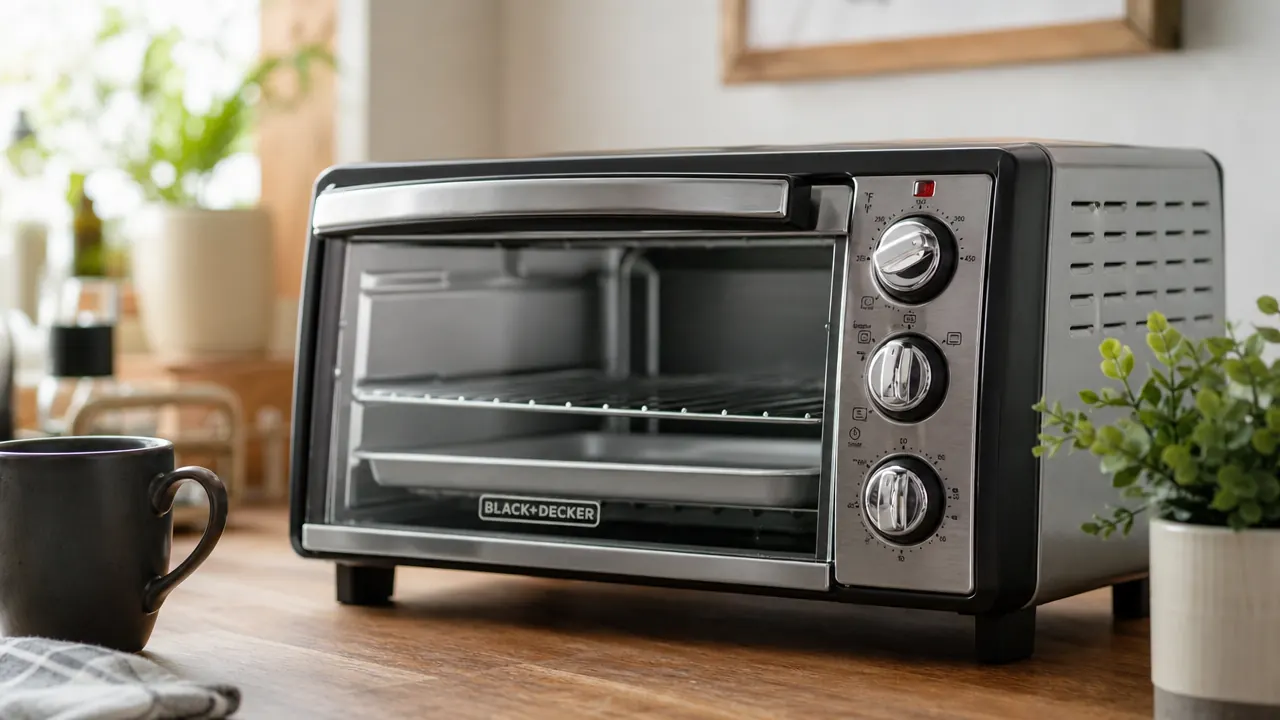
The timer on the TO1760SS is a mechanical dial that you turn clockwise to set a duration up to 30 minutes. For toast, there is a separate stay-on position. The function selector dial, the one with settings for bake, broil, and convection, has a satisfying click when you move it between positions. The timer knob does not have that same feel. It turns smoothly but without any tactile confirmation that it is set where you want it. The markings on the knob are also small enough that in low kitchen light I sometimes have to lean in to confirm I hit the right time. It is a minor thing and it does not affect cooking results in any way. But it is the one control on the machine that feels slightly below the quality of the rest of it, and more than a few people in the Amazon reviews mention it, so I am not alone in noticing.
If you want a side-by-side look at how the TO1760SS controls compare to a higher-end option, my BLACK+DECKER vs Breville Mini Smart Oven comparison covers exactly that, including whether the Breville's digital controls are worth the significant price increase for most small-kitchen cooks. Short answer: for everyday use, they are not.
Who This Is For
The TO1760SS is the right oven for anyone cooking solo or for two in a kitchen where the counter footprint is a real constraint and the cooking is practical rather than precision. If your needs run to daily toast, reheated leftovers, and simple roasts of vegetables and protein, this oven handles all of it without drama once you build the three habits I described above: preheat properly, compensate for temperature, and line the crumb tray before fatty cooks. The cost is low enough that if it holds up for two or three years, it will have paid for itself in full-size oven electricity savings alone. For context on whether a toaster oven can genuinely replace your range oven for most meals, I have a piece on the specific tasks where the swap works best: BLACK+DECKER TO1760SS Long-Term Review.
Who Should Skip It
If precision baking is a regular part of your cooking, the calibration requirements of the TO1760SS will wear on you. Bakers who need consistent temperatures within five degrees, or who work with delicate pastries that cannot tolerate a hot corner, would be better served by an oven with digital temperature control and a powered convection fan. This oven is also not the right fit for cooking for three or four people. At 4-slice capacity, you will be running it in batches, which is workable but not efficient for a larger household. And if you are the kind of cook who prefers to slide food in and let the oven do all the work without any setup adjustments, the habits this oven requires may feel like more effort than you signed up for. That is a fair position. This is an oven that rewards a modest learning curve; if you are not interested in that curve, look at options with digital controls that handle calibration for you.
Once you know the three surprises, the TO1760SS stops being a frustration and starts being the most-used appliance in a small kitchen.
It is not a perfect oven. It is a practical, compact, well-priced oven that does its job reliably for cooks who are willing to spend two weeks learning its quirks. Check the current price on Amazon to see if it fits your budget.
Amazon Check Today's Price on Amazon →